
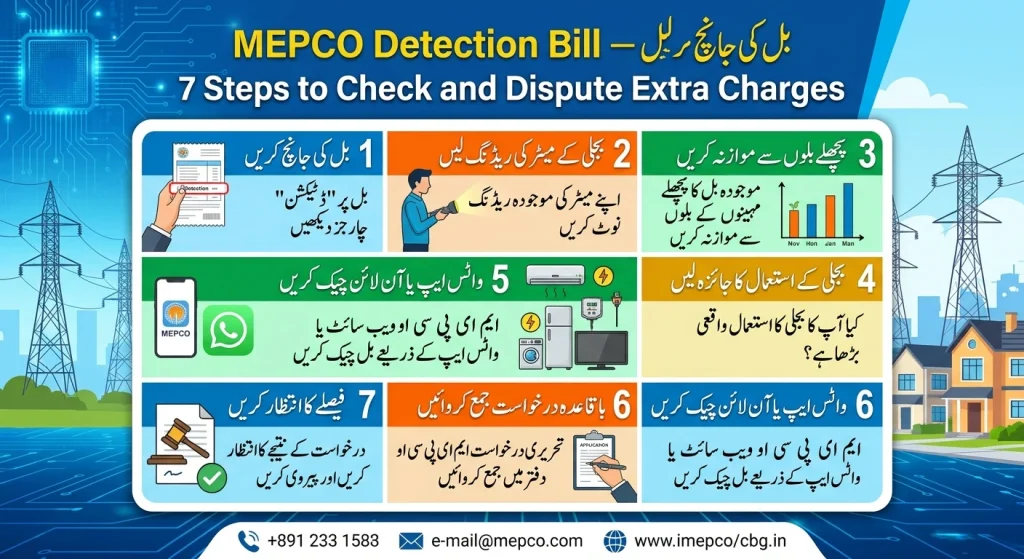
MEPCO Detection Bill – 7 Steps to Check and Dispute Extra Charges
A MEPCO Detection Bill can create serious financial concerns when an electricity consumer receives unexpected charges in addition to the regular monthly bill. These charges may relate to suspected electricity theft, meter tampering, an abnormal meter condition, or another detected irregularity. However, consumers should be able to understand why the bill was issued and how the amount was calculated.
If you have received a detection bill from the Multan Electric Power Company (MEPCO), do not ignore it or pay without reviewing the details. First, check the inspection record, billing period, units, calculation method, and supporting documents. If you believe the charges are incorrect, you can submit a written objection and request a review.
This guide explains seven practical steps to check a MEPCO detection bill, identify possible errors, and dispute extra electricity charges through the appropriate channels.
What Is a MEPCO Detection Bill?
A MEPCO detection bill is an additional electricity charge issued when the distribution company identifies a suspected irregularity involving electricity consumption, metering, or unauthorized use of electricity. It is separate from the consumer’s normal monthly bill.
A detection bill may be associated with situations such as:
- Suspected direct electricity supply or unauthorized connections.
- Alleged meter tampering or bypassing.
- A meter found to be recording consumption incorrectly.
- Other irregularities identified during an inspection.
The reason for the bill matters because different situations may have different assessment and billing procedures. A detection bill should provide relevant details, including the reason, units, amount, assessment period, and applicable taxes. Consumers should request the supporting inspection and calculation records if these details are missing.
7 Steps to Check and Dispute a MEPCO Detection Bill
1. Read the Detection Bill Carefully
Start by examining the detection bill and comparing it with your regular electricity bill. Check the consumer name, reference number, connection category, billing month, and total amount.
Pay particular attention to the following details:
- Reason for issuing the detection bill.
- Number of additional units charged.
- Period covered by the assessment.
- Rate and calculation of charges.
- Taxes and other adjustments.
- Any inspection or detection reference mentioned.
If the bill does not clearly explain these details, visit your concerned MEPCO subdivision office and request a written explanation.
2. Verify the Meter Inspection Report
The meter inspection report is an important document when disputing a detection bill. Ask MEPCO for a copy of the inspection report, meter testing record, photographs, and any other evidence used to determine the alleged irregularity.
Check whether the report identifies the meter condition and explains what was observed during the inspection. Also verify the inspection date and meter details against your actual connection.
If the report contains incorrect information or does not relate to your meter, mention these points in your written objection. Keep copies of all documents provided by MEPCO.
3. Check the Detection Period and Units
One of the most important parts of a MEPCO Detection Bill is the period for which additional electricity consumption has been assessed.
Compare the detection period with your previous electricity bills and available meter-reading records. Check whether the number of units appears reasonable and whether the assessment follows the applicable Consumer Service Manual.
The NEPRA Consumer Service Manual (CSM), revised as of November 26, 2025, contains rules for detection billing, including assessment methods and applicable limits. For general supply consumers, certain detection assessments are restricted to three billing cycles, with a possible extension up to six months subject to the specified approval. Other consumer categories may have different limits.
Do not assume that every detection bill follows the same time limit. The applicable rule depends on the type of alleged irregularity and consumer category.
4. Compare Previous Electricity Consumption
Your previous electricity bills can help you identify whether the detection assessment is reasonable.
Collect at least several months of previous bills and compare:
- Monthly electricity units.
- Previous meter readings.
- Consumption trends.
- Connection load and category.
- Any unusual changes in the billed amount.
The applicable rules specify an order of priority for calculating detection units. Previous credible consumption may be relevant before other assessment methods are considered.
If MEPCO has used an assessment method that does not appear consistent with the applicable rules, request a written calculation and explain the discrepancy in your complaint.
5. Submit a Written Complaint to MEPCO
If you find incorrect units, an unsupported inspection claim, an excessive assessment period, or calculation errors, submit a written complaint to your concerned MEPCO Sub-Divisional Officer (SDO) or relevant office.
Your application should include:
- Consumer name and reference number.
- Copy of the detection bill.
- Copies of previous electricity bills.
- Copy of your CNIC, if required.
- Meter photographs or inspection-related evidence.
- A clear explanation of why you dispute the charges.
Ask the receiving office to provide an acknowledgment or complaint reference number. Keep a copy of your application and all submitted documents for future follow-up.
6. Request a Review Committee Hearing
If you formally dispute the detection bill, you can request a review by the MEPCO review committee.
Under the revised Consumer Service Manual, the review committee is the designated forum for revision of a disputed detection bill, and the consumer should be given a personal hearing.
During the hearing, explain your objections clearly. For example, you may point out an incorrect meter number, missing inspection evidence, an inaccurate assessment period, or a calculation that does not follow the applicable rules.
Take copies of your bills, inspection documents, photographs, and written complaint. Request a copy of the committee’s decision so you can understand the outcome and consider further action if necessary.
7. Escalate the Complaint to NEPRA if Needed
If MEPCO does not resolve your complaint satisfactorily, you may consider approaching the National Electric Power Regulatory Authority (NEPRA) through its Consumer Affairs Department.
Before escalating, keep the following records ready:
- Original or copy of the disputed detection bill.
- MEPCO complaint number and application.
- Review committee decision, if available.
- Inspection report and meter testing documents.
- Previous electricity bills and relevant evidence.
- A brief timeline explaining the issue.
You can use NEPRA’s official online complaint system to register and track an eligible complaint. Provide accurate information and attach supporting documents.
Official complaint portal: https://nepra.org.pk/CAD-Database/CMS-CAD/cregister.php
How Is a MEPCO Detection Bill Calculated?
The calculation depends on the nature of the detected irregularity and the applicable rules. The Consumer Service Manual provides methods for assessing detection units, including consideration of previous consumption, relevant undisputed consumption, and other prescribed calculation methods where applicable.
For this reason, consumers should not rely only on the total amount printed on the bill. Request a detailed calculation showing:
- Total detection units.
- Assessment period.
- Method used to calculate units.
- Applicable electricity rates.
- Taxes and additional charges.
- Adjustments for units or amounts already billed or paid, where applicable.
A written calculation makes it easier to identify errors and explain your objection.
Important Documents to Keep
Keep these documents together when dealing with a disputed detection bill:
| Document | Why It Is Important |
|---|---|
| Detection bill | Shows the disputed amount and assessment details |
| Previous electricity bills | Helps compare consumption history |
| Meter inspection report | Explains the reason for detection |
| Meter photographs | Provides supporting visual evidence |
| CNIC copy, if required | Helps verify consumer information |
| Complaint acknowledgment | Proves that you submitted an objection |
| Review committee decision | Records the outcome of the review |
Can MEPCO Disconnect Electricity Over an Unpaid Detection Bill?
A disputed detection bill should not simply be ignored. The Consumer Service Manual describes the procedure that may apply if a consumer does not pay a detection bill after the review process and within the stipulated period.
If you have challenged the amount, keep proof of your complaint and ask MEPCO in writing about the payment and disconnection position while the dispute is being considered. Do not assume that submitting a complaint automatically suspends every payment or disconnection requirement.
For guidance about your specific case, contact the relevant MEPCO office and review the applicable rules.
Frequently Asked Questions
1. What is a MEPCO Detection Bill?
It is an additional electricity bill issued when MEPCO identifies a suspected irregularity involving electricity consumption, metering, or unauthorized use. It is separate from the regular monthly bill.
2. Can I dispute a MEPCO Detection Bill?
Yes. You can submit a written objection to the concerned MEPCO office and request a review by the designated review committee. You should provide supporting documents and explain why you believe the charges are incorrect.
3. Which documents are required to challenge detection charges?
You should keep the detection bill, previous electricity bills, meter inspection report, relevant photographs, complaint acknowledgment, and identification documents if requested by MEPCO.
4. Can I complain to NEPRA against MEPCO?
If your complaint is not resolved through the appropriate MEPCO process, you may approach NEPRA through its official Consumer Affairs complaint system, subject to the applicable complaint requirements.
5. Where can I check the rules for detection billing?
You can consult the revised NEPRA Consumer Service Manual and the official NEPRA website for applicable electricity consumer regulations and complaint procedures.
Conclusion
Receiving a MEPCO Detection Bill does not mean you should accept every additional charge without checking its details. Review the assessment period, units, inspection report, calculation method, and previous electricity consumption before deciding what to do.
If you identify an error, submit a written complaint to MEPCO and request a review committee hearing. Keep all bills, inspection records, complaint numbers, and decisions safely. If the issue remains unresolved, you can consider escalating it to NEPRA through its official complaint system.
Understanding the applicable rules and keeping proper documentation can help you challenge incorrect detection charges and protect your consumer rights.